
Acupuncture
Acupuncture and moxibustion following Yuncheng Institute protocols — gentle neurological stimulation through biologically active points.
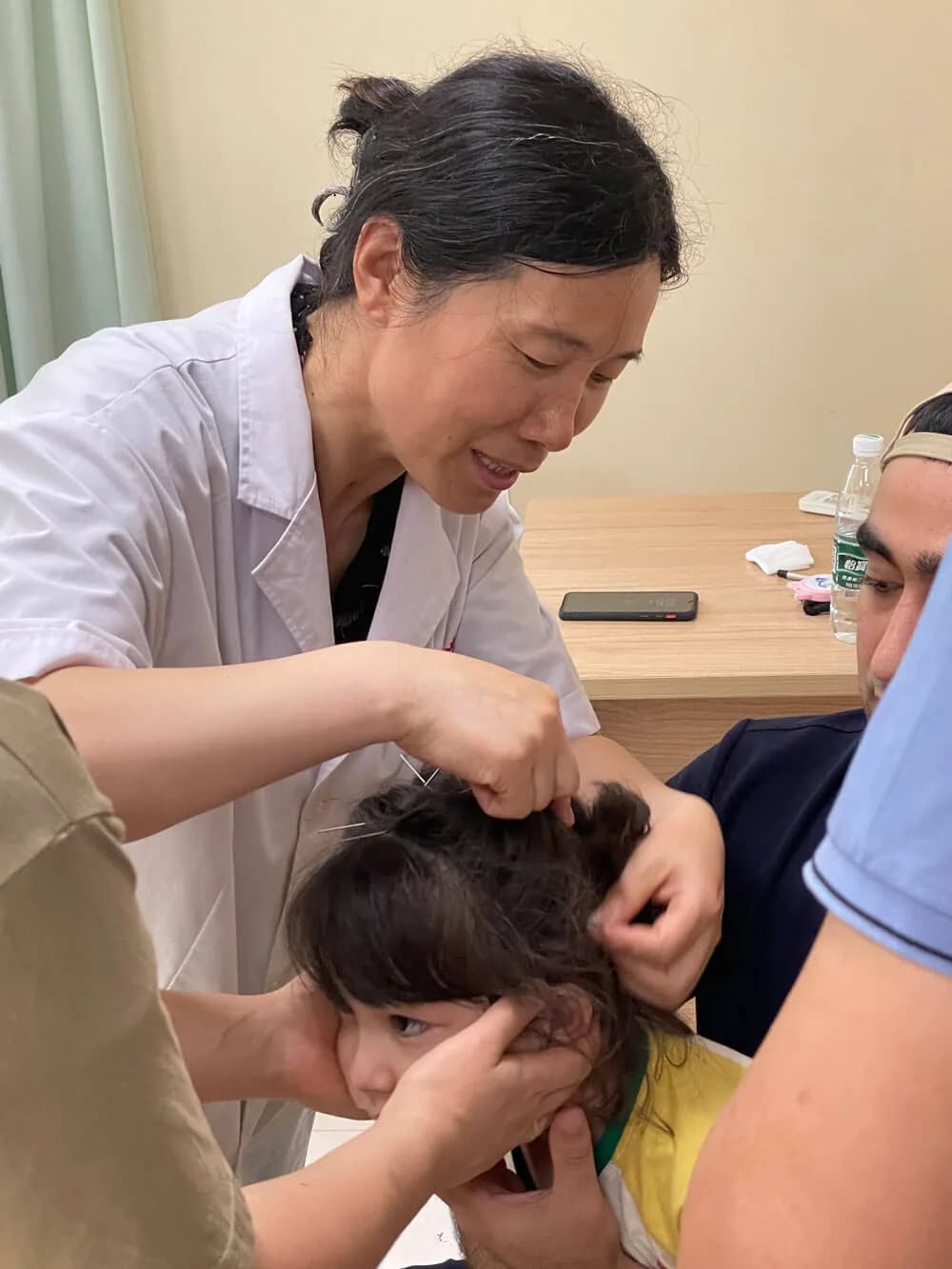
How the procedure works
Acupuncture is one of the cornerstones of traditional Chinese medicine and a flagship procedure at our Huizhou centre. We employ seven distinct directions: scalp (cerebral) acupuncture to modulate central nervous system activity; paravertebral acupuncture targeting spinal nerve pathways; facial and eye acupuncture for swallowing, mimic and visual function; limb acupuncture to refine coordination and muscle tone; abdominal acupuncture supporting genitourinary innervation; electroacupuncture for peripheral nerve damage and traumatic brain injury rehabilitation; electropuncture — a synthesis of TCM and European physiotherapy. Our protocols originate from the Yuncheng Institute of Acupuncture under Professor Jiao Shunfa (焦顺发); direct disciples of the professor practise at our Huizhou clinic, preserving the lineage of the technique.
Protocol selection
The diagnosis and the state of the meridians are assessed; a personalised protocol is selected: scalp, spinal, or a combined approach.
Session
Sterile thin needles are inserted into biologically active points. Where indicated, electrostimulation, moxibustion or electropuncture are added.
Wrap-up
Supervised rest, post-session recommendations, progress notes in the patient's chart and scheduling of follow-up sessions.
How Sessions Look
Indications and contraindications
Indications
Contraindications
Who performs the procedure

Bobur Kurbanov
Founder of the Neurolife Center. Expert in pediatric rehabilitation.

Liu Hejian刘合建
One of the founders of the Neurolife center. Expert in pediatric rehabilitation.

Dong Mingcheng董明程
Head of the Neurolife International Pediatric Rehabilitation Center. Specialization: Neurorehabilitation specialist, Orthopedist
What diagnoses it helps with Acupuncture
Book a free consultation
A doctor will review your documents and provide recommendations within 30 minutes.